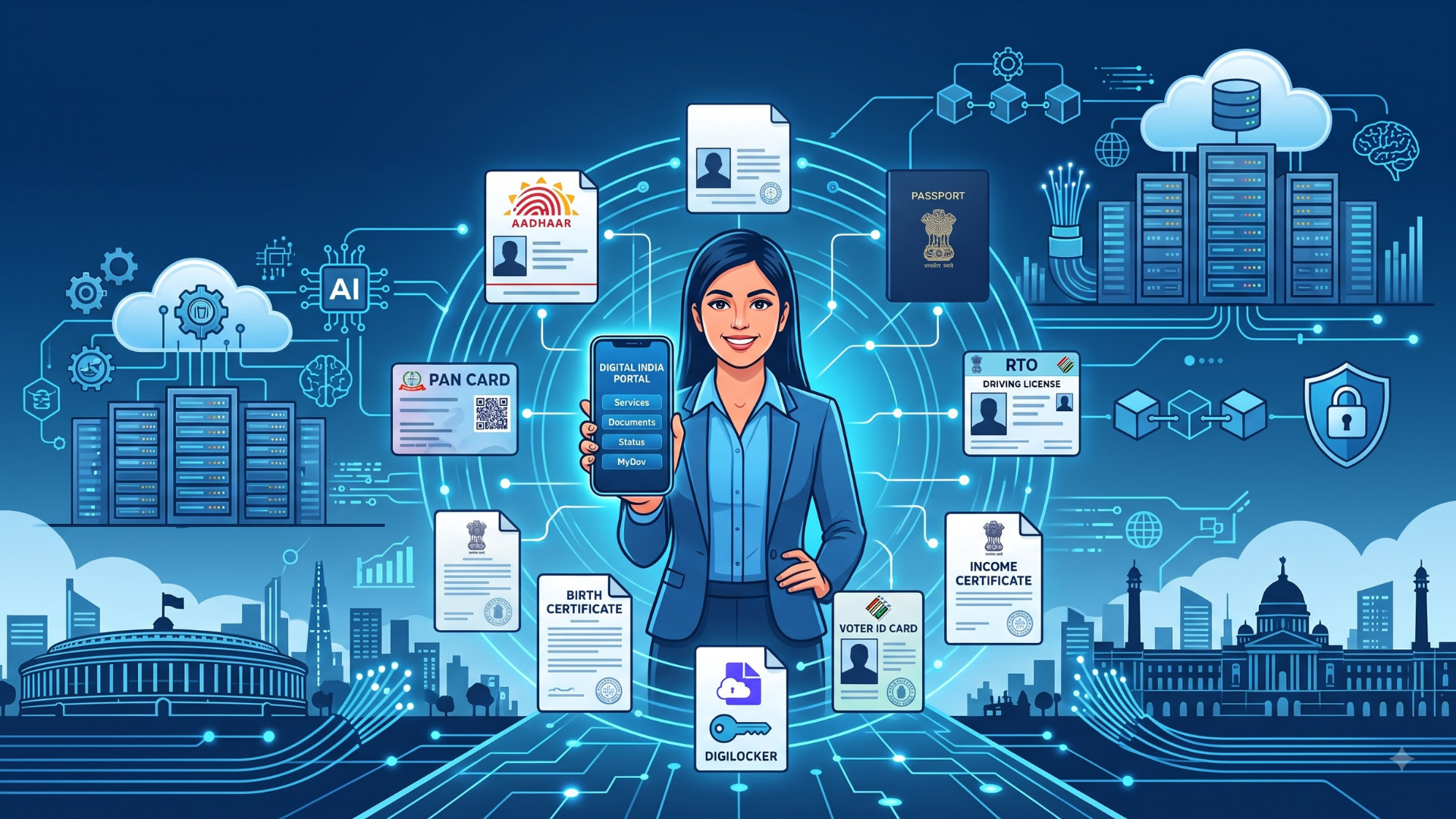
Automating Government Document Creation in India: A Step Towards Smarter Governance

Automating Government Document Creation in India: A Step Towards Smarter Governance
Abstract
The last decade has seen India make giant leaps in digital governance with initiatives like Aadhaar, DigiLocker, UMANG and Digital India. But even with these developments, the process of obtaining government documents is still complicated and time-consuming for many citizens. People go from one government office to another, giving the same information again and again and waiting for long stretches of time for verification procedures. These inefficiencies add to administrative costs, delay in public services and unwarranted inconvenience. This article discusses the challenges of the present document management system in India and a proposed integrated automation framework, linking government departments on a single digital platform. This system could decrease paperwork, increase transparency, increase citizen satisfaction and increase the effectiveness of public administration.
Introduction
Government documents are the foundation of citizen’s identity and access to public services. Important documents like birth certificates, Aadhaar cards, PAN cards, voter IDs, passports, driving licenses, income certificates, caste certificates, and domicile certificates are needed for education, employment, banking, healthcare, taxation, and travel.
And while many of these services have been digitized, the process remains fragmented. Each government department is a silo with its own database, verification procedures and application portals. This means citizens have to provide the same information again and again, even if the government already has a lot of that data in its own system.
In a country of more than 1.4 billion people, making it easier to produce government documents by using automation is not just a technology improvement. It is a necessity for good government.
Challenges in the Existing System

One of the biggest issues is the lack of integration between government departments. For example, when applying for a passport, applicants need to provide proof of identity, proof of address, date of birth and a number of supporting documents. There are databases like Aadhaar in the government where this information is already available but applicants have to re-upload or re-submit them.
Repetitive documentation is another big problem. Every time they apply for a new service, citizens have to fill in their personal information (name, date of birth, address, parents’ names and contact details) over and over again. This duplication is a waste of administrative resources and the applicant’s time.
Manual verification adds to delays as well. In spite of digital records, we see that officials are still very much into the practice of going over physical documents and performing cross checks. Also with human intervention comes the issue of clerical errors and inconsistencies. As for another issue, we see that in urban areas people benefit from online services but in rural and remote areas which are large in number, there is low internet connectivity, low digital proficiency, and also a lack of access to Common Service Centers. Also in these outlying areas people have to travel great distances to do what should be simple administrative tasks. Also we see that there is a lack of communication between departments which in turn causes issues with the consistency of citizens’ records. To change an address or to correct a spelling mistake often requires going to different government agencies which in turn makes the process slow and frustrating.
Proposed Automation Framework

Such challenges can be addressed by India with Unified Government Document Automation Platform. This platform would connect multiple government agencies through secure APIs and verified data sources.
The process will begin with secure citizen authentication via Aadhaar or any other put in digital identity system. Once logged in, the system would automatically draw verified personal information from existing government databases instead of requiring citizens to re-enter the same information over and over.
Automated verification systems and artificial intelligence could verify documents, flag missing information, identify duplicate applications and reduce the manual workload. Verified digital records would then be sent to the relevant departments for approval.
Upon successful verification, the document will be auto-saved in DigiLocker and digitally signed with an official digital signature or QR code, so that citizens can access it at any time without needing to hold physical copies.
Such a system would reduce paperwork significantly while maintaining security and transparency.
Benefits of Automation
The implementation of an automated document generation system brings benefits.
First it would greatly cut down the time it takes to process things. Tasks that now take days or even weeks could be done in hours or minutes for many regular services.
Second automation would cut down on repeated paperwork by letting people use information that has already been checked and is stored in government databases.
Third government departments would have work to do. Employees could spend time on complicated cases while the automated systems take care of simple checks.
There would also be openness. People could see where their applications are at any moment which helps reduce confusion and lowers the chance, for corruption that comes from much manual work.
Automation will help us save money in the run by using less paper, which means we pay less for storage and printing. We will also have costs, for administration.
Furthermore if we have one system that everything runs on our government records will be more consistent. This will help reduce mistakes in the data when different departments are working with it.
Challenges in Implementation
Although automation offers significant advantages, implementing such a system presents several challenges.
Data privacy must remain the highest priority. As personal info will be shared between departments that which may be sensitive in nature we put in very strict compliance to data protection laws, encryption policies and cyber security practices.
We will be dealing with cyber security issues which include but not limited to hacking, identity theft, ransom wear attacks and unauthorised access which will require we have in place a robust security structure. Also we have issue of interoperability.
At present each government department uses different software platforms and database structures. What we will have to do is care fully plan and invest greatly in to integrate these legacy systems into a unified platform. Also we have the issue of the digital divide.
We have citizens without smart phones, internet access or digital literacy which we will support through Common Service Centers and assisted digital services. Also we will need to see in to place legal and admin reforms which will put in standardized procedures for digital verification, electronic approvals and secure inter dept data sharing.
Future Scope
The future of government document automation goes beyond apps. New technologies like Artificial Intelligence, Machine Learning, Blockchain and cloud computing can make public administration better.
Artificial Intelligence can check documents automatically find applications and offer smart help using chatbots that speak many languages.
Blockchain can create records that cannot be changed, making people trust the system more and stopping documents.
Connecting with recognition, biometric checks and digital signatures can make things safer and easier to check.
In the end a single digital system, for government work could let people get all services through one safe website making everything faster and making people happier.
Conclusion
India has already built a digital base using programs like Aadhaar, DigiLocker and Digital India.. The full power of digital governance will only show up when government departments work as one connected system instead of separate parts.
Making government document creation would make official tasks easier cut down on paper use make things more open and give people quicker and more dependable services. Even though there are problems with security, private information and the tools needed smart planning and proper steps can solve these issues well.
A single platform for automating documents is not a new technology but also a big move, toward putting people first in government. By using automation India can build a better more open and easier public service system that helps all people.